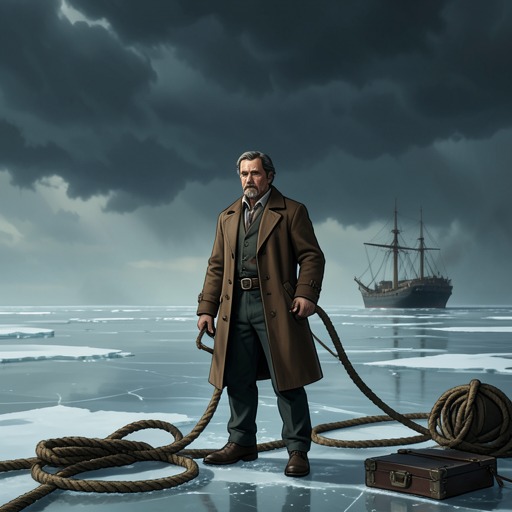
Sinking of the Percival after striking an iceberg
The North WaterThe Sinking of the Percival after striking an iceberg was a maritime disaster that cost eighteen lives and erased the value of a full cargo of blubber. It also became a dividing line in Arthur Brownlee’s life at sea: although the loss left the surviving crew unable to resume their former work, Brownlee eventually returned and commanded another ship.
The Loss and Its Cost
The Percival was crushed by an iceberg three years before the disaster was discussed in the book. Its holds were full of blubber, but not a single barrel was recovered. Eight men drowned and ten more died from the cold. Those who survived received no meaningful share of the lost cargo’s value; none made even sixpence from it.
The disaster therefore meant more than the destruction of a ship and its freight. The crew’s labor had produced a valuable cargo, yet the sinking left no recoverable return for the men who had survived. Its stark arithmetic—eighteen dead, a lost hold, and no payment to survivors—makes the episode an early illustration of how the hazards of whaling could transfer the consequences of commercial loss onto crews.
Brownlee After the Wreck
Brownlee survived and, unlike the other survivors, returned to sea. The account describes the others as too profoundly affected by the disaster to go back; Brownlee alone managed to continue. His return is presented as evidence of stubbornness, or perhaps poor judgment, rather than as proof that the sinking had left him untouched.
The wreck also shaped his prospects as a captain. A captain associated with such a disastrous loss would not ordinarily be expected to secure another ship, yet Brownlee did. His later command of the Volunteer thus carries the history of an unlikely return: the Percival’s loss was not the end of his seafaring career, even though it ended that of the other survivors.
Memory and Significance
The Percival recurs as part of Brownlee’s account of his own past. When he tells stories of the coal barge and the wreck, he does not present his history as something to hide; he treats past mistakes and suffering as experiences a man must bear. Elsewhere, the memory is linked to the practical fact that he was the only survivor who went back to sea. The wreck consequently functions both as a catastrophe in its own right and as a measure of the persistence that distinguishes Brownlee from the rest of the surviving crew.
The episode also stands against the book’s account of a declining whaling industry. Brownlee recalls an earlier period when a successful voyage could return with great quantities of valuable whalebone, while later whaling required costly machinery and luck. The Percival’s lost blubber makes that commercial exposure concrete: a cargo could be accumulated through dangerous labor and then vanish in a single encounter with ice, leaving neither the goods nor a payment for the men who had survived.